Nitrate film is an early cellulose-nitrate film stock that requires specialist identification, handling and storage because it is highly flammable and chemically unstable. If you discover old cine film that you think could be nitrate, the safest approach is to avoid projecting, cleaning or extensively unrolling it and seek advice from a film archive or appropriately trained specialist. The BFI specifically advises members of the public who discover nitrate film to contact it for safe handling and storage guidance. BFI
A sensible first assessment is:
- Check the film gauge – nitrate is most strongly associated with older 35mm motion-picture film.
- Look for edge markings such as “NITRATE” or “SAFETY”, without extensively unrolling uncertain film.
- Consider its age and provenance – early cinema material deserves particular caution.
- Check for visible deterioration without deliberately smelling or manipulating the film.
- Keep it away from heat, flames and ignition sources.
- Don’t put questionable film through a projector.
- Ask a specialist to confirm its film base before cleaning, repairing, scanning or transferring it.
The key point is that identification and preservation should come before attempts to watch the footage.
What Exactly Is Nitrate Film?
Nitrate film uses cellulose nitrate as its transparent film base. It played a fundamental role in early motion-picture photography and was widely used from cinema’s beginnings until safer film stocks superseded it.
The BFI describes nitrate as the principal motion-picture film stock from the 1890s into the 1950s. Its physical qualities made it sufficiently tough for repeated passage through cameras and projectors, while the photographic image could have impressive clarity and tonal qualities. BFI
Its major disadvantage was safety.
Cellulose nitrate is highly combustible. Furthermore, nitrate becomes chemically less stable as it deteriorates. The BFI consequently stores its archival nitrate collection in purpose-designed cold-storage facilities rather than treating it like ordinary cine film. BFI
This distinction matters if you’ve discovered an unidentified reel in a loft, garage, cupboard or inherited collection. Old film should not automatically be assumed to be harmless acetate “safety film”.
How Can You Identify Nitrate Film?
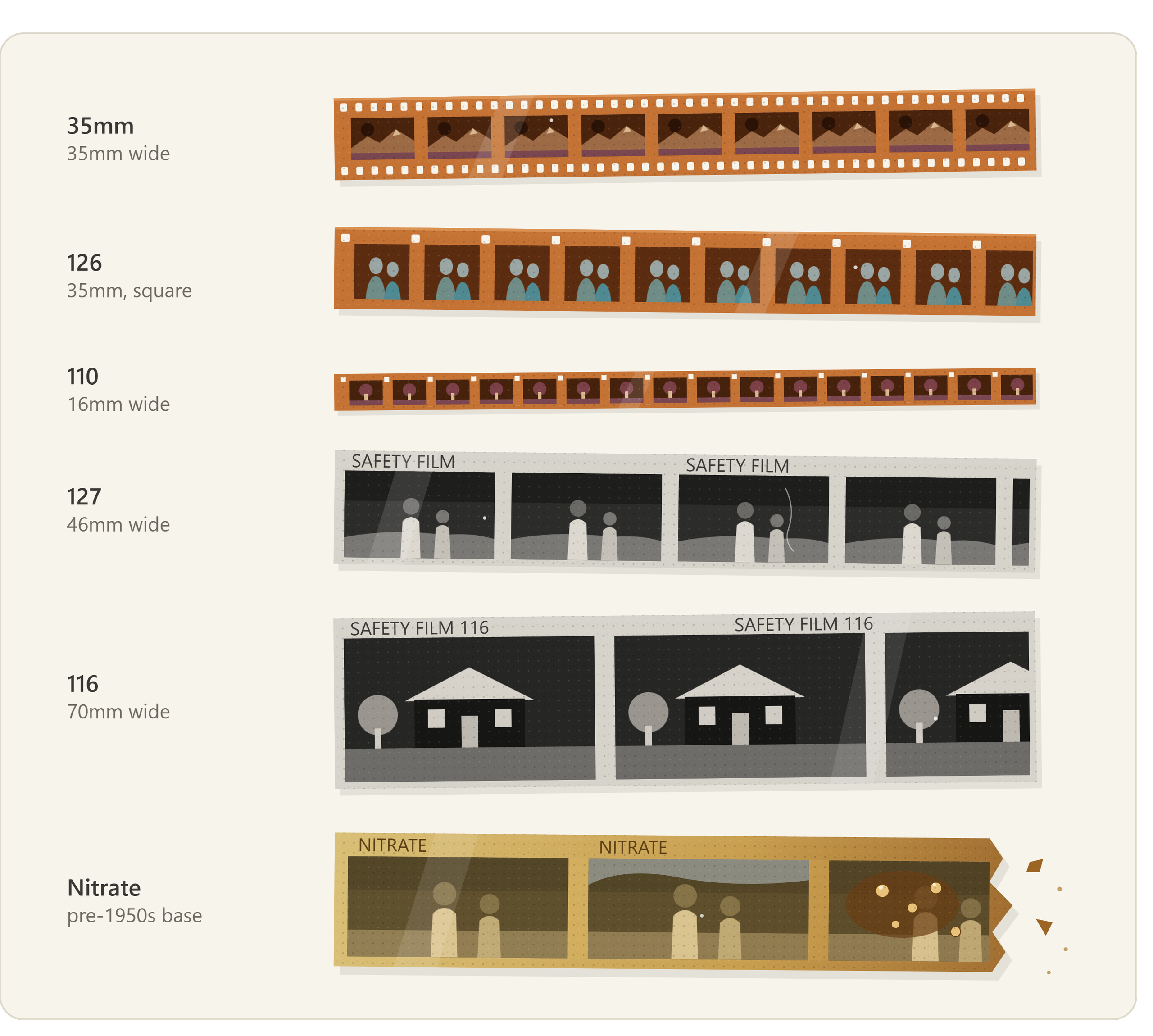
There is no single visual test that a member of the public should regard as conclusive. Identification is better approached by combining film gauge, approximate date, edge markings, packaging, physical condition and specialist examination.
Check the Film’s Edge Markings
Film manufacturers sometimes printed identifying information along the edge of the film.
If an accessible section of the film clearly says NITRATE, that is an important warning. Conversely, many later stocks carry “SAFETY” markings identifying a non-nitrate base.
However, absence of a readable marking does not establish that a reel is safe.
Markings can be missing from a particular section, obscured by deterioration or difficult to read. A reel can also contain material assembled from different sources.
Treat edge markings as evidence rather than relying upon them as the only identification method.
Consider the Gauge
Film width is another useful clue.
Nitrate is particularly associated with 35mm motion-picture film. Smaller amateur formats became popular on safety bases partly because they were intended for use outside professional cinemas.
That means finding an old 35mm reel deserves more scrutiny than finding a typical family Super 8 film.
Gauge alone still cannot prove the film base. Both nitrate and safety materials exist in 35mm, so the fact that a reel measures 35mm does not establish what it is made from.
Look at the Date and History
The age of a film can help narrow the possibilities.
The BFI notes that nitrate was used from cinema’s earliest period until around the mid-1950s, with acetate safety stocks eventually replacing it. BFI
Therefore, a reel known to date from the early decades of cinema deserves particular caution.
Labels on the original can are also valuable. BFI archivists note that old film containers can provide clues about a film’s provenance and storage history, although labels aren’t necessarily reliable proof of what is currently inside the can. BFI
Keep original cans, labels and paperwork with a collection rather than discarding them during sorting.
Nitrate Film vs Safety Film
The term “safety film” can cause confusion because it doesn’t necessarily mean that an old film is chemically stable.
| Characteristic | Nitrate film | Acetate safety film | Polyester film |
|---|---|---|---|
| Base | Cellulose nitrate | Cellulose acetate | Polyester |
| Fire risk | Highly flammable | Much lower than nitrate | Much lower than nitrate |
| Common historical association | Early cinema | Later film and replacement for nitrate | Modern film stocks |
| Can deteriorate chemically? | Yes | Yes | More chemically stable |
| Typical deterioration concern | Progressive nitrate decomposition | Vinegar syndrome | Generally more stable |
| Specialist identification worthwhile? | Yes | Often, particularly if deteriorated | Sometimes |
Acetate film deserves attention in its own right. It can suffer from vinegar syndrome, where chemical deterioration causes acetic acid to be released and the film can shrink and become brittle. BFI
So “not nitrate” does not necessarily mean “in perfect condition”.
What Does Deteriorating Nitrate Film Look Like?
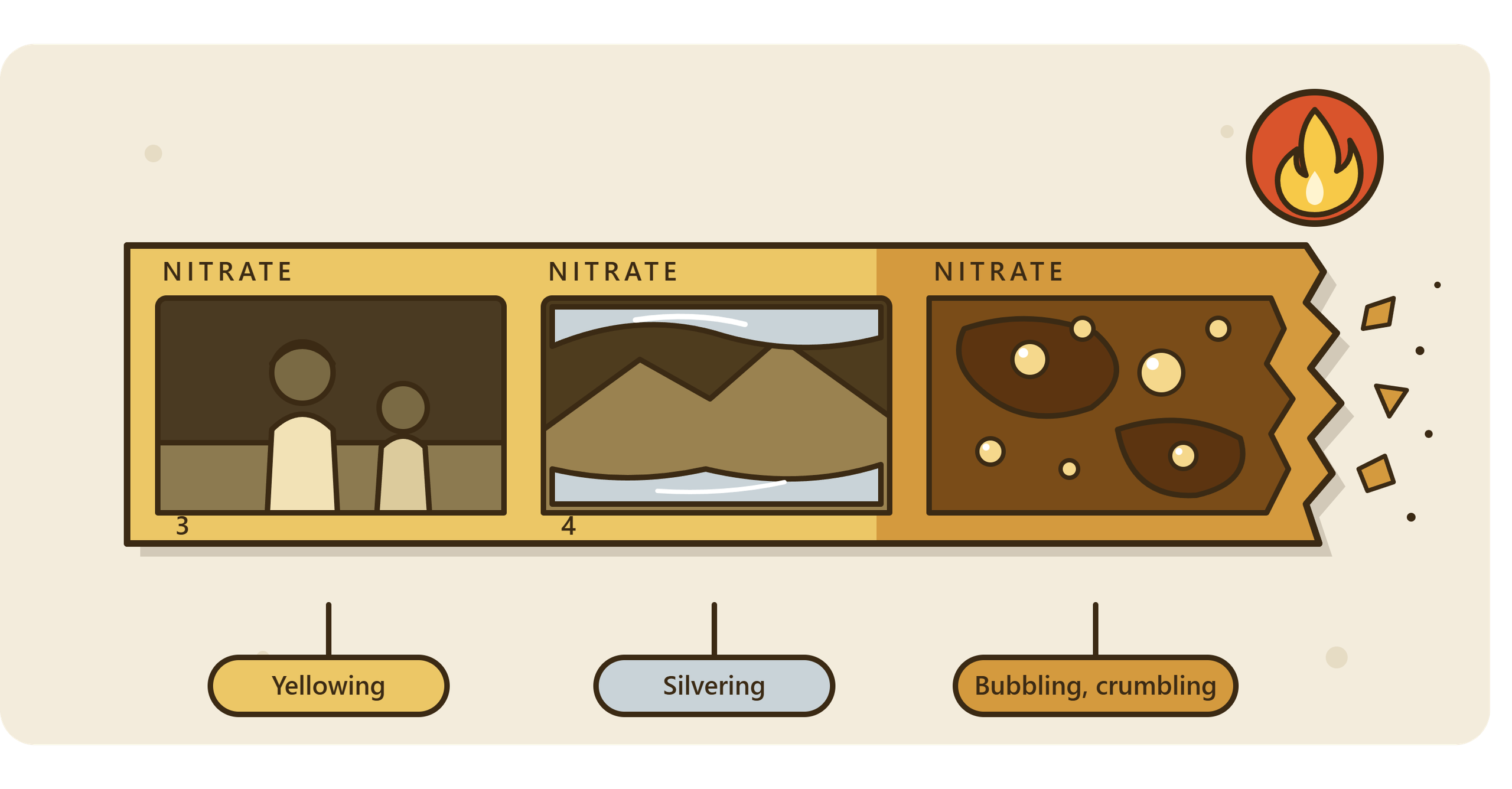
Nitrate deterioration can progress substantially, and badly affected material should not be investigated by repeatedly opening, unwinding or manipulating it.
Potential warning signs can include:
- discolouration;
- fading or changes to the image;
- stickiness;
- brittleness;
- deformation;
- material adhering together;
- severe physical deterioration;
- eventual breakdown of the film base.
The Library of Congress notes that deteriorating cellulose nitrate can become acidic, sticky and brittle. It can also release compounds capable of damaging nearby photographic material. The Library of Congress
The BFI similarly explains that once nitrate decomposition begins, deterioration can become rapid and ultimately leave the material in a severely degraded state. BFI
This creates another reason to isolate suspected nitrate material from an ordinary family film or photographic collection and obtain expert guidance.
How Should You Handle Suspected Nitrate Film?
The safest rule for an untrained owner is simple: handle it as little as possible until it has been properly identified.
The BFI says nitrate-film handling requires trained archivists and explicitly advises the public not to handle nitrate film without appropriate training. BFI
If you discover a reel that may be nitrate:
- keep it away from naked flames and sources of heat;
- don’t smoke near it;
- don’t run it through a domestic projector;
- don’t attempt DIY chemical cleaning;
- don’t deliberately burn a piece to identify it;
- don’t repeatedly unwind it looking for markings;
- don’t attempt repairs with household adhesive tape;
- don’t mix deteriorating film with the rest of your collection;
- obtain professional advice before deciding how it should be moved or stored.
The National Archives identifies cellulose nitrate film as material with potentially hazardous chemical and physical properties and uses dedicated safe-handling procedures for such material. The National Archives
Why Is Nitrate Film a Fire Risk?
The danger isn’t simply that nitrate film “burns easily”.
Once cellulose nitrate is burning, the reaction can sustain combustion in circumstances where people might expect a conventional fire to be extinguished. The BFI explains that combustion produces oxygen as part of the reaction, making an established nitrate fire exceptionally difficult to extinguish. BFI
That is why professional archives don’t store nitrate alongside ordinary media under normal room conditions.
The BFI’s nitrate holdings are kept in purpose-built facilities. Its Master Film Store maintains nitrate and other master material at -5°C and 35% relative humidity, with controlled acclimatisation before films are worked on. BFI
Those specifications illustrate professional archival practice; they should not be interpreted as instructions to place unidentified nitrate reels into an ordinary domestic freezer.
Common Mistakes When You Discover Old Nitrate Film
Trying to Project It
The temptation is understandable: you’ve found an old reel and want to know what’s on it.
Don’t start by projecting suspected nitrate.
Ageing film can have damaged perforations, weakened splices, shrinkage and other physical problems. Nitrate adds an additional fire hazard.
Professional nitrate projection is a specialist undertaking. The BFI describes extensive inspection and specialised projection safeguards used when original nitrate prints are screened. BFI
Using a Flame Test
Historical identification advice sometimes refers to burning a small sample of film.
That is not an appropriate DIY identification technique.
If the purpose of the exercise is to establish whether an unknown material is dangerously combustible, deliberately setting fire to it defeats the principle of safe identification.
Assuming an Old Tin Identifies the Film
Keep the tin—but don’t trust it completely.
Reels get moved, containers get reused and handwritten descriptions can be wrong. As BFI archivists point out, film cans can provide valuable information but can also provide false leads. BFI
Assuming “Safety” Means the Film Is Healthy
Safety film primarily distinguishes the material from highly flammable nitrate stock. Older acetate film can nevertheless deteriorate substantially through vinegar syndrome. BFI
Should Nitrate Film Be Digitised?
Where material can be safely conserved and scanned, digitisation can be an important way of preserving access to its photographic content.
Professional archives use digital scanning as part of nitrate preservation and restoration. The BFI has digitally scanned and restored original nitrate materials, while modern archival scanning equipment can employ low-tension transport systems designed to minimise stress on delicate film. BFI
However, digitisation and physical preservation aren’t the same thing.
A digital file preserves access to the images; it does not turn the original nitrate into a stable material. Archives may retain significant original nitrate elements under specialist conditions because the physical film itself can have historical and evidential value.
For ordinary family collections, the first question should therefore be “What is this film and is it safe to handle?”, followed by “How should we preserve its contents?”
If your material is confirmed as a conventional cine format suitable for transfer, Supaphoto provides a professional service for preserving old movie footage digitally.
Can Nitrate Film Still Produce a Good Digital Image?
Potentially, yes.
Age alone doesn’t determine image quality. A surviving nitrate element may retain considerable photographic information if it has survived in suitable condition.
The BFI has described nitrate’s distinctive image qualities and continues to preserve original nitrate materials alongside preservation and digital copies. BFI
The quality obtainable during digitisation depends on factors including:
- original exposure and focus;
- film generation – for example, original negative versus later print;
- physical shrinkage;
- scratches and surface damage;
- chemical deterioration;
- image density;
- stability of perforations and splices;
- scanning equipment and technique.
A fragile film may require conservation assessment before it can safely travel through scanning equipment.
What Should You Do If You Find Nitrate Film at Home?
If you genuinely suspect nitrate, avoid turning identification into a DIY experiment.
Don’t project it, burn-test it, aggressively clean it or extensively unroll it. Keep it away from heat and ignition sources, minimise handling and seek specialist advice.
The BFI’s public guidance is particularly relevant in the UK: it advises anyone who discovers nitrate film in a private collection to contact the BFI for guidance concerning safe storage and handling. BFI
Once the material has been positively identified and its condition assessed, you can make an informed decision about conservation, specialist storage and whether its images can be safely digitised.
Ultimately, irreplaceable historic film deserves more than trial and error. Where old cine material requires identification, preparation or digitisation, it makes sense to use an experienced professional organisation, such as Supaphoto Ltd, while suspected nitrate itself should first be assessed according to appropriate specialist safety guidance.