
Choosing the right Heritage Scanning Company is about far more than creating digital copies. The best providers preserve the integrity of historic collections while producing accurate, accessible digital files that can be used for research, education and long-term preservation.
Before selecting a company, compare:
- Experience with heritage collections
- Safe handling procedures
- Specialist scanning equipment
- Image quality and colour accuracy
- File formats and metadata
- Quality assurance processes
- Security and confidentiality
- Long-term digital preservation advice
Why Heritage Scanning Matters
Historic documents, photographs, manuscripts and artwork naturally deteriorate over time. Frequent handling, fluctuating temperatures, humidity, light exposure and accidental damage all contribute to their decline.
Professional digitisation helps reduce physical handling while allowing collections to be viewed by researchers, family members, staff and the public without risking unnecessary wear. Digital copies also provide valuable protection should the originals ever be damaged through flood, fire or accidental loss.
Many organisations now include digitisation within wider preservation programmes. Museums, local authorities, universities, churches, libraries and private collectors all use digital archives to improve access while safeguarding irreplaceable material.
For organisations managing mixed collections, combining books, maps, photographs and archive material into a single organised digital collection often creates significant efficiencies. Services such as heritage collection digitisation allow different record types to be preserved within one structured archive.
Not Every Collection Needs the Same Approach
One of the biggest mistakes people make is assuming every historic item can be scanned using identical equipment.
Different originals require different capture methods.
| Collection | Typical approach |
|---|---|
| Manuscripts | Overhead scanning with careful page support |
| Historic maps | Large-format capture |
| Bound volumes | Non-destructive book scanning |
| Posters | Large-format scanning |
| Fine artwork | Colour-managed photographic capture |
| Glass negatives | Specialist transparency scanning |
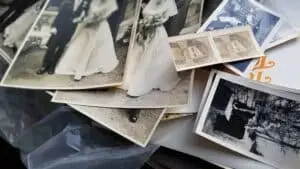
| Historic photographs | High-resolution flatbed capture |
A company experienced in office document scanning may have little experience working with fragile parchment, rolled plans or delicate nineteenth-century photographs.
Experience Matters More Than Equipment
Modern scanners are impressive, but the operator is often more important than the machine.
Experienced technicians understand:
- how to handle brittle paper
- when an item should not be flattened
- how to support damaged bindings
- how to minimise handling
- how to preserve page order
- when colour calibration is essential
- how to identify scanning problems before delivery
Large heritage projects often contain items produced over several centuries using different papers, inks and photographic processes. Each requires a different workflow.
Collections containing paintings, illustrations or historically significant artwork may also benefit from museum-quality artwork reproduction where accurate colour management is essential.
Questions Every Heritage Scanning Company Should Answer
Before committing to a project, ask:
- Have you worked with similar collections?
- How are fragile items protected?
- What happens if material requires conservation before scanning?
- Which file formats are supplied?
- How are digital files quality checked?
- Can metadata be captured?
- How will originals be packaged and returned?
- Where will scanning take place?
- How are confidential collections protected?
- Can you provide sample scans?
A reputable provider should answer these questions confidently and explain the reasoning behind its recommendations rather than offering identical solutions for every project.
Resolution Is Only One Part of Image Quality
Many buyers concentrate entirely on scanning resolution.
While resolution is important, excellent digitisation also depends upon:
- accurate colour reproduction
- correct exposure
- even lighting
- precise focus
- faithful tonal range
- minimal distortion
- careful cropping
- consistent orientation
A poorly captured 1200 dpi scan is often less useful than a carefully produced 400 dpi master image.
Ask to review sample files before the full project begins.
File Formats and Digital Preservation
Different projects require different outputs.
| Format | Best use |
|---|---|
| TIFF | Long-term preservation master |
| JPEG | Everyday viewing |
| Complete documents | |
| Searchable PDF | Research and archives using OCR |
| PNG | High-quality graphics |
Many organisations request both preservation masters and smaller access copies. This provides maximum flexibility without repeatedly editing the original master files.
The British Library’s digitisation guidance explains how high-quality digital surrogates improve access while supporting the preservation of physical collections.
Metadata Is Just as Important as the Scan
Without good metadata, even beautifully scanned collections quickly become difficult to search.
Useful metadata may include:
- title
- creator
- date
- location
- collection number
- catalogue reference
- keywords
- copyright status
- document type
Consistent metadata allows researchers to locate material within seconds rather than searching through thousands of filenames.
Security and Chain of Custody
Many heritage collections contain confidential information alongside historical value.
A professional provider should explain:
- secure transport
- controlled storage
- restricted staff access
- backup procedures
- encrypted file delivery
- deletion policies for temporary working files
This becomes particularly important for council archives, medical collections, business records and legal documents.
Quality Assurance Should Never Be an Afterthought
Scanning is only one stage of a professional workflow.
Every project should include checks for:
- missing pages
- incorrect orientation
- colour consistency
- cropped edges
- blurred images
- duplicate files
- file naming
- metadata accuracy
Robust quality control prevents expensive corrections after thousands of images have already been delivered.
The National Archives’ guidance on digitisation highlights the importance of planning, preparation and quality assurance throughout heritage digitisation projects.
Common Mistakes to Avoid
Avoid these common errors when selecting a Heritage Scanning Company:
- Choosing purely on price.
- Assuming all scanners produce identical results.
- Ignoring file organisation and metadata.
- Requesting unnecessarily high resolutions.
- Forgetting long-term digital storage.
- Disposing of originals without considering legal or historical obligations.
Planning a Successful Heritage Digitisation Project
A successful heritage digitisation project begins long before the first item is scanned. Careful planning helps ensure the finished archive is organised, searchable and capable of serving its intended purpose for many years. Before work begins, identify the types of material within the collection, estimate quantities, prioritise fragile or high-value items and determine how the digital files will be used. A project created primarily for public online access may require different file formats and metadata than one intended for internal research or long-term preservation. Establishing naming conventions, folder structures and metadata standards from the outset prevents confusion later and makes it far easier to integrate newly digitised material into existing catalogues or digital asset management systems. An experienced Heritage Scanning Company should assist with this planning stage, offering practical advice that improves efficiency while reducing unnecessary handling of valuable originals.
Why Professional Heritage Scanning Delivers Better Long-Term Value
While low-cost scanning services may appear attractive, heritage collections require a level of care and expertise that general document scanning companies often cannot provide. Historic books, maps, manuscripts and photographs frequently vary in size, condition and construction, meaning every project benefits from an individual approach rather than a standard production-line workflow. Professional heritage scanning captures not only the visible content but also the subtle detail, texture and colour that may be historically significant. Equally important is the consistency of the final archive. Uniform cropping, accurate colour management, reliable file naming, embedded metadata and rigorous quality assurance all contribute to a collection that remains useful for decades rather than just producing a series of disconnected digital images.
Choosing a specialist provider also offers reassurance that your originals are handled safely throughout the project. Established Heritage Scanning Companies employ documented handling procedures, secure storage, controlled workflows and multiple quality checks before returning every item to its owner. This attention to detail reduces the risk of accidental damage while ensuring the finished digital archive accurately represents the original collection. Whether preserving a local history archive, church records, engineering drawings, museum collections or private family documents, investing in professional heritage digitisation creates an enduring resource that improves accessibility today while safeguarding historically important material for future generations.
Frequently Asked Questions
Can fragile heritage documents be scanned safely?
Yes. Professional heritage scanning uses handling methods appropriate to the condition of each item, often with overhead capture systems that minimise physical stress.
Can damaged documents be digitised?
Often they can. Minor tears, folds and ageing usually do not prevent scanning, although severely damaged items may require conservation before digitisation.
Should original documents be discarded after scanning?
Not automatically. Many historical documents have continuing legal, evidential or heritage value even after digitisation.
How long do digital archive files last?
Digital files require ongoing management. Multiple backups, routine integrity checks and migration to newer storage media help ensure long-term accessibility.
Choosing with Confidence
The best Heritage Scanning Company combines technical expertise with an understanding of historical preservation. Rather than focusing solely on scanners or resolution, look for experience with heritage collections, careful handling procedures, comprehensive quality assurance and practical advice on digital preservation.
A well-managed digitisation project protects valuable originals while making them easier to search, share and preserve for future generations.