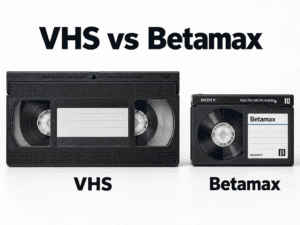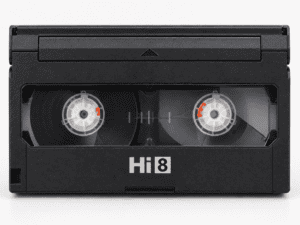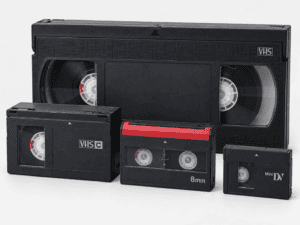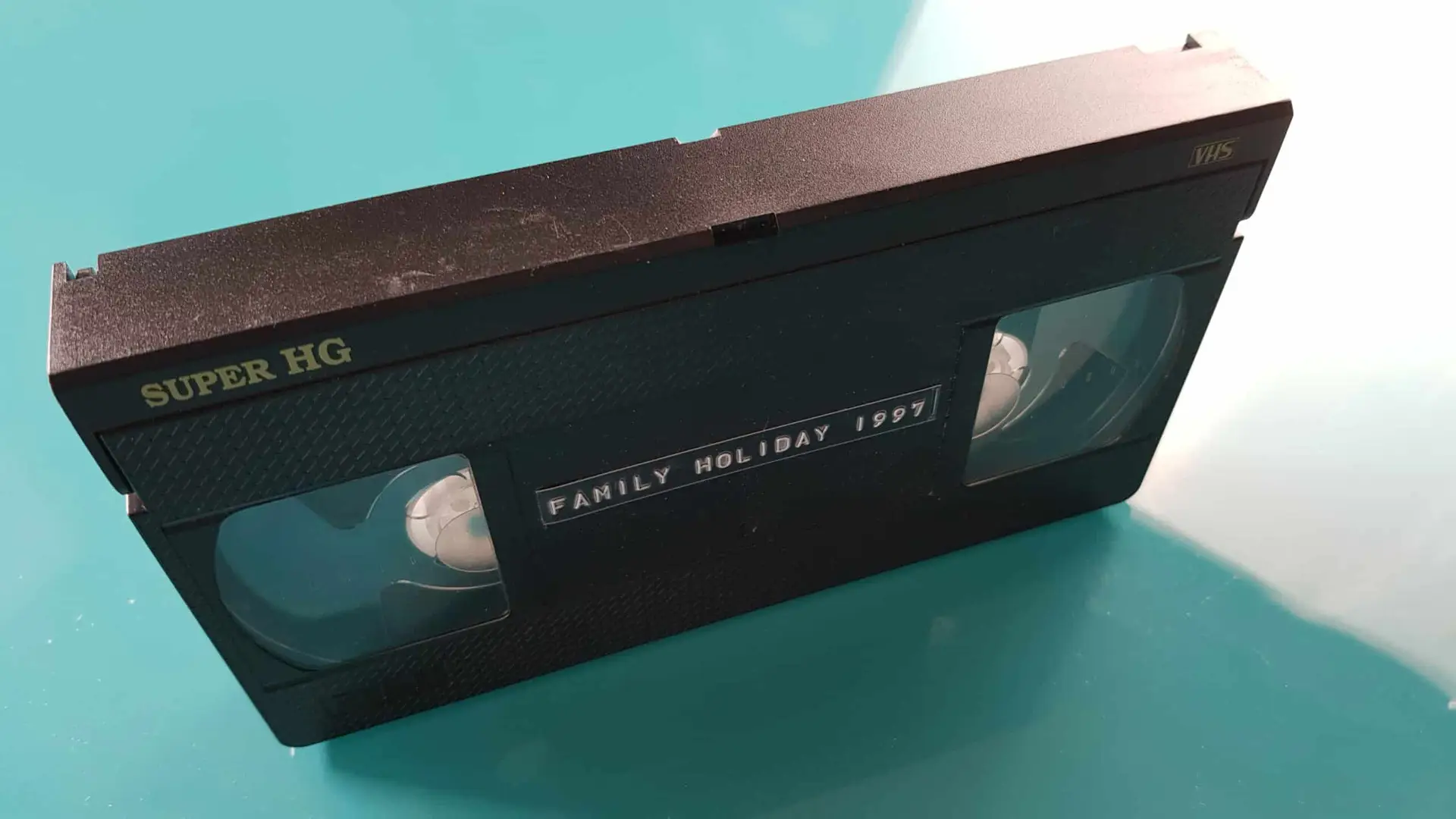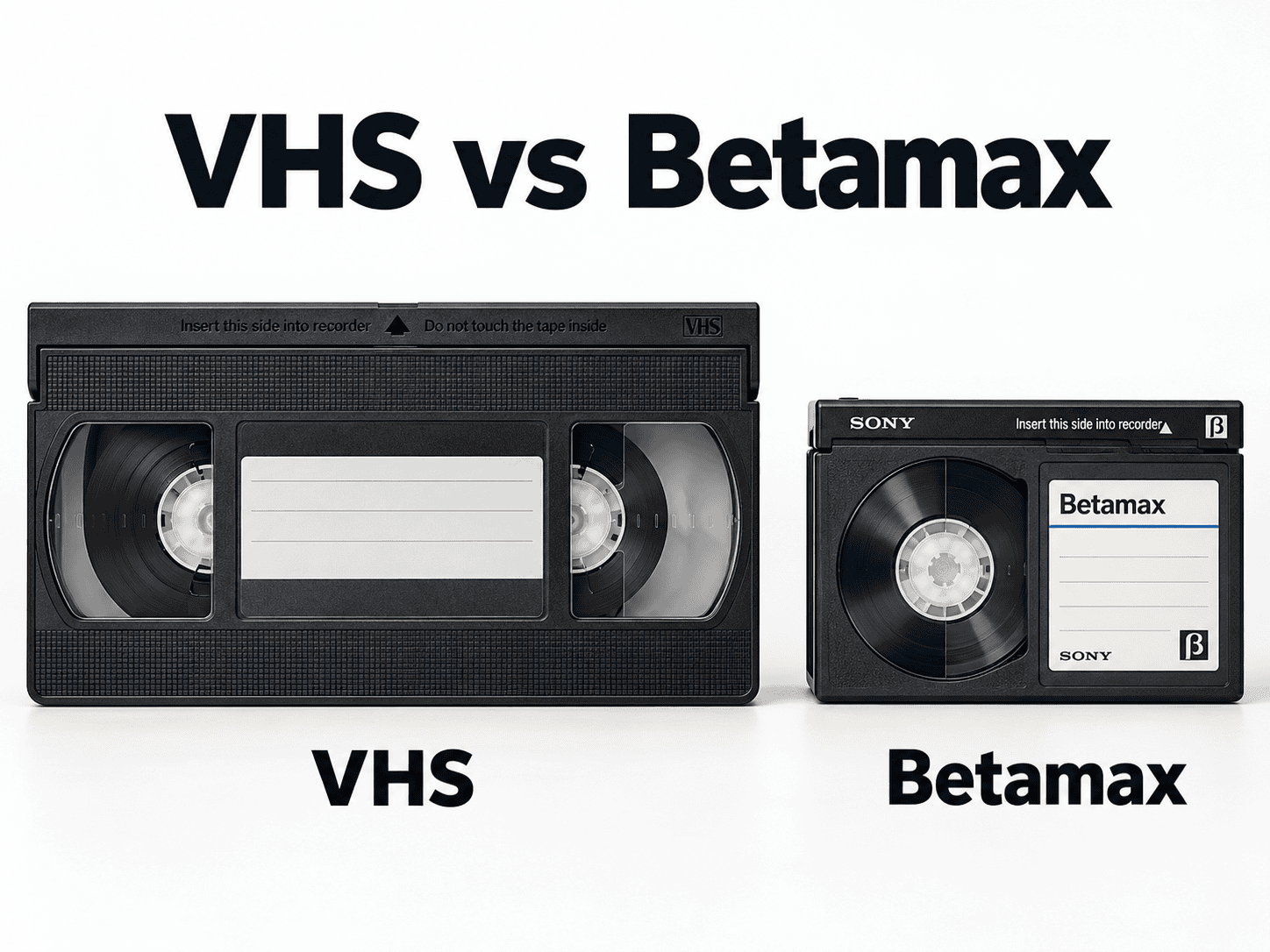

In the VCR vs Betamax format war, Betamax generally earned the stronger reputation for picture quality, while VHS became the dominant home-video system because it offered longer recording times, wider manufacturer support, lower costs and greater availability. In practical terms, VHS won the market even though Betamax retained several technical strengths.
| Comparison | VHS | Betamax |
|---|---|---|
| Introduced | 1976 by JVC | 1975 by Sony |
| Cassette size | Larger | Smaller |
| Early recording time | Longer | Shorter |
| Picture quality | Good | Often regarded as better |
| Manufacturer support | Very broad | More restricted |
| Rental-market presence | Dominant | Much smaller |
| Long-term market winner | Yes | No |
Sony launched Betamax first, but being first was not enough. The eventual winner was the format that proved more convenient and widely available to ordinary households.
Betamax Arrived First
Sony introduced Betamax in Japan in 1975, bringing domestic television recording much closer to the mainstream.
The National Science and Media Museum describes Betamax as one of the major developments that helped make home television recording practical, although earlier video systems such as U-matic and Philips’ N1500 had already appeared. Its history of home video explains how Betamax helped bring recording into ordinary homes.
JVC followed with VHS in 1976.
That one-year advantage might appear decisive, but the format battle eventually depended on far more than the launch date.
Betamax Had the Early Technical Advantage
Betamax has often been remembered as the technically superior system.
Early Betamax machines could produce a slightly sharper-looking picture than comparable VHS equipment, and Sony continued improving the format through developments such as Beta Hi-Fi and Hi-Band Beta.
Sony’s own 1985 annual report described Hi-Band Beta as an improved recording method designed to provide superior picture quality.
However, picture quality was never the only feature buyers cared about.
For many households, recording capacity proved more important.
Recording Time Became One of VHS’s Biggest Advantages
Early Betamax recordings were comparatively short.
That created a practical problem: viewers wanted to record complete films, sporting events and long television programmes without changing cassettes.
VHS offered longer recording times relatively early in its development.
For the average household, that was an obvious benefit.
Imagine choosing between:
- slightly better picture quality but needing more than one cassette for a long programme
- slightly softer picture quality but recording the whole programme on one tape
A large number of consumers preferred convenience.
Betamax later increased its recording capacity considerably, but VHS had already gained important ground.
VHS Was an Open Door for More Manufacturers
Another major factor was JVC’s approach to licensing VHS.
A wide range of electronics manufacturers adopted the VHS system.
That helped create:
- more VCR models
- greater competition
- falling prices
- wider retailer availability
- more repair expertise
- more VHS cassette production
Betamax remained strongly associated with Sony and a smaller number of manufacturers.
As VHS hardware became more common, buying VHS increasingly felt like the safer choice.
This created a powerful network effect.
The more people owned VHS machines, the more retailers stocked VHS tapes. The more tapes retailers stocked, the more attractive VHS became to new buyers.
Video Rental Shops Helped VHS Pull Ahead
The explosion of home-video rental strengthened this advantage.
Rental businesses had limited shelf space and needed to stock the format most customers could use.
As VHS ownership increased, shops devoted more space to VHS.
That meant VHS owners found:
- more films
- more copies
- easier rentals
- greater choice
Consumers considering their first VCR could see which format local rental shops supported most strongly.
That encouraged even more VHS sales.
The market gradually reinforced itself.
Did Betamax Really Have Better Picture Quality?
Broadly speaking, early Betamax had a picture-quality advantage, but the answer becomes more complicated when comparing later machines and recording modes.
Analogue video quality depends on factors including:
- recording mode
- tape condition
- deck quality
- video-head condition
- signal quality
- generation loss
- television standard
Later VHS developments narrowed the gap significantly.
S-VHS, for example, improved luminance resolution substantially compared with conventional VHS.
Likewise, Betamax continued evolving.
So it is too simplistic to say that every Betamax recording looks better than every VHS recording.
A well-recorded VHS tape played on an excellent machine can easily outperform a poorly recorded or deteriorated Betamax cassette.
What Does VHS Actually Stand For?
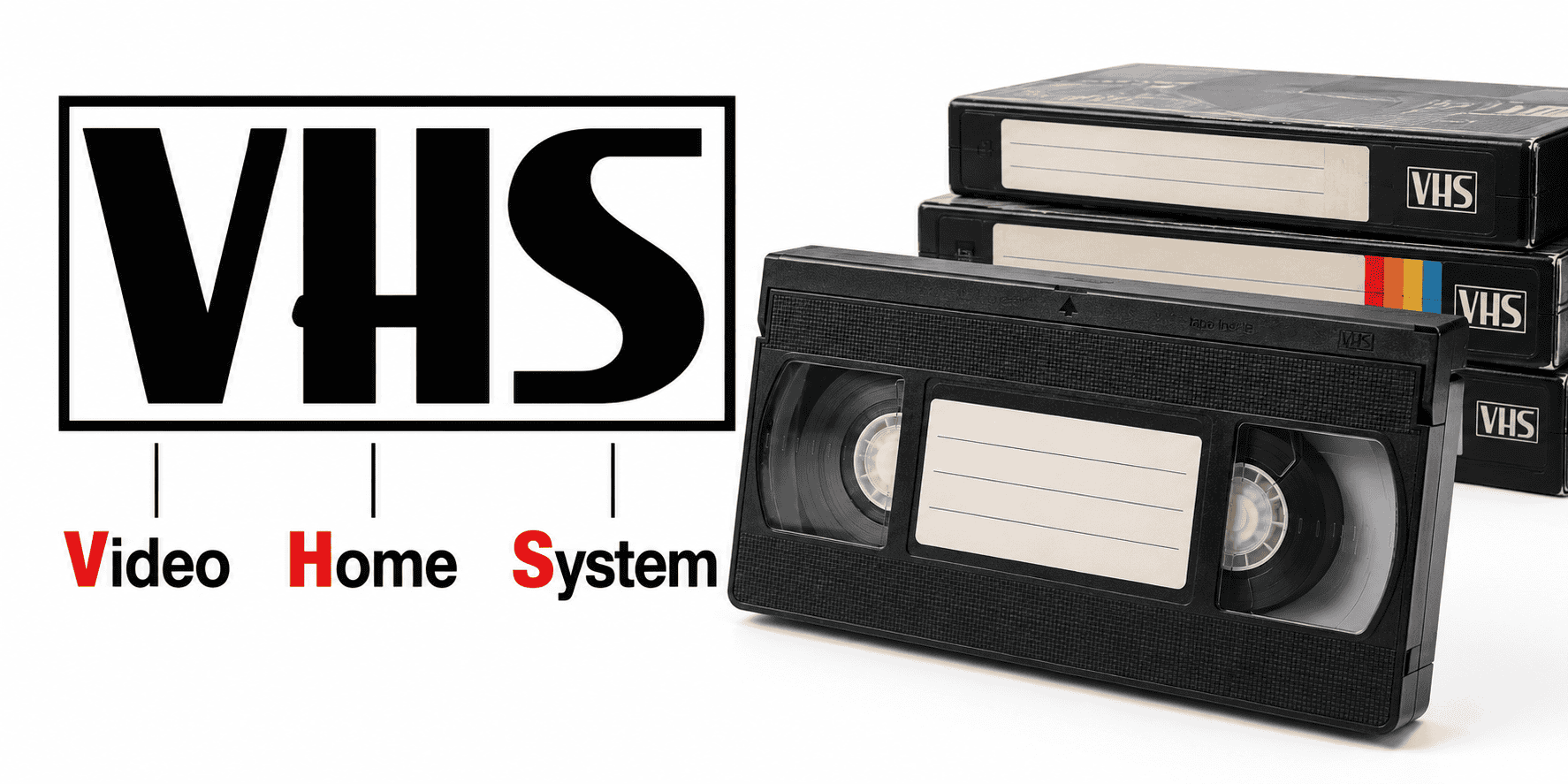
VHS stands for Video Home System.
JVC developed it as a consumer videotape format using ½-inch magnetic tape inside a rectangular cassette.
The format became synonymous with home video throughout the 1980s and 1990s.
For millions of households, the word “video” effectively came to mean VHS.
People used the machines for:
- recording television
- watching rental films
- playing purchased films
- viewing family footage transferred from camcorders
- time-shifting programmes
That enormous installed base helped VHS remain relevant long after the format war itself had ended.
Betamax and Betacam Are Not the Same Thing
This causes frequent confusion.
Betamax was Sony’s domestic home-video format.
Betacam was a professional broadcast-video family.
Although the names sound similar and the cassette design shared some heritage, they served very different markets.
Betacam became highly successful in professional television production.
Sony’s 1988 annual report described Betacam as widely used by television stations and highlighted its picture quality and suitability for electronic news gathering.
So saying “Beta lost to VHS” applies to the domestic Betamax format, not to Sony’s professional Betacam systems.
Why Cassette Size Didn’t Decide the Winner
Betamax cassettes were physically smaller than VHS cassettes.
That sounds like an advantage, and from an engineering point of view it could make the system appear neater.
But consumers generally cared more about:
- price
- recording time
- film availability
- machine availability
- reliability
- ease of use
VHS’s larger cassette did little to deter buyers once the format became widely established.
This is a useful reminder that technical elegance does not always determine commercial success.
Was VHS Cheaper?
Price played a substantial role.
Because many companies manufactured VHS machines, competition increased rapidly.
More manufacturers meant buyers had access to:
- basic budget machines
- mid-range machines
- premium decks
- combination televisions and VCRs
- portable machines
Retailers could offer VHS equipment across a broad range of price points.
This helped VHS move from expensive new technology into a normal household appliance.
Betamax faced a harder battle once VHS reached this level of market penetration.
Did the Adult-Film Industry Decide the VHS vs Betamax War?
This is one of the most repeated stories about the format battle.
The adult-video industry probably contributed to VHS adoption because VHS became widely available for many types of prerecorded content.
However, reducing the entire outcome to pornography oversimplifies what happened.
VHS had several larger structural advantages:
- longer recording times
- more manufacturers
- lower-cost hardware
- strong rental-market adoption
- wider prerecorded-film availability
Adult video formed part of the broader content market rather than being the single reason VHS succeeded.
Did Betamax Disappear Immediately?
No.
Betamax continued for many years after VHS became the clear market leader.
Sony kept improving its equipment, and loyal users continued using the format.
By the mid-1980s, however, Sony itself was reporting declining Betamax VTR sales under competitive pressure. Its 1985 annual report explicitly noted falling Betamax sales despite the introduction of improved Hi-Band Beta models.
The format war therefore ended gradually rather than on a single date.
What About Picture Quality in the UK?
UK video systems generally used PAL rather than the NTSC television system common in North America and Japan.
PAL uses 625 interlaced lines at 25 frames per second, while NTSC uses 525 interlaced lines at approximately 29.97 frames per second. Sony’s explanation of the television standards confirms these fundamental differences.
That means comparisons based entirely on American NTSC machines do not always translate perfectly to UK PAL equipment.
The exact machine, recording standard and tape remain important.
VHS Eventually Improved Considerably
VHS did not remain technically frozen.
Manufacturers added features such as:
- VHS Hi-Fi audio
- improved heads
- long-play modes
- better noise reduction
- automatic tracking
- S-VHS
- improved picture processing
Premium VHS and S-VHS decks eventually became extremely sophisticated.
This makes it difficult to assign one fixed picture-quality figure to “VHS”.
An early 1970s-generation VHS machine and a high-end 1990s S-VHS deck belong to the same broad format family but can deliver noticeably different results.
Why VHS Won: The Five Main Reasons
The result of the format war becomes much clearer when viewed from the consumer’s perspective.
1. Longer Recording Times
Households could record longer films and programmes conveniently.
2. More Manufacturers
Widespread licensing created more hardware choice.
3. Lower Prices
Competition between manufacturers drove costs down.
4. Larger Rental Libraries
Video shops increasingly favoured the format with the largest customer base.
5. Network Effect
More VHS owners encouraged more VHS content, which attracted even more VHS owners.
Betamax’s technical strengths could not overcome this combination.
Which Format Is Easier to Digitise Today?
VHS is generally easier simply because more playback machines survive and replacement equipment remains easier to source.
Betamax equipment is less common.
That makes careful handling particularly important when working with old Beta tapes because suitable decks are now ageing specialist equipment.
The digitisation process itself also depends on more than the cassette format.
Good results require:
- a suitable playback machine
- clean video heads
- stable signal timing
- correct PAL or NTSC handling
- good analogue-to-digital conversion
- proper audio capture
- suitable digital file settings
For old family recordings, careful conversion of VHS and other analogue videotapes into modern digital files can remove the need to keep relying on increasingly old playback equipment.
Should You Keep VHS and Betamax Tapes After Digitising Them?
Yes, where practical.
The cassette remains the original recording medium.
Even after a successful transfer, keeping the original gives you the possibility of making another capture in the future.
Store tapes:
- upright
- in protective cases
- away from damp
- away from excessive heat
- away from strong magnetic fields
- in a stable indoor environment
Do not repeatedly play ageing tapes unnecessarily.
If you see mould, damaged tape or mechanical problems, avoid putting the cassette into a valuable machine until it has been assessed.
Frequently Asked Questions About VCR vs Betamax
Was Betamax better quality than VHS?
Early Betamax generally offered better picture quality than early VHS, but later developments on both sides made the comparison more complicated.
Recording mode and playback equipment can matter as much as the format.
Why did VHS beat Betamax?
VHS combined longer recording time, broad manufacturer support, competitive pricing and strong rental-market availability.
Those practical advantages proved more important to many consumers than Betamax’s technical strengths.
Did Sony invent VHS?
No.
Sony developed Betamax.
JVC developed VHS.
Is Betacam the same as Betamax?
No.
Betamax was designed for the domestic market, while Betacam became a professional broadcast-video family.
Can a VHS tape play in a Betamax machine?
No.
The cassettes and recording systems are incompatible.
Is Betamax worth anything today?
Some machines, tapes and rare prerecorded releases can have collector value, particularly well-preserved equipment and unusual editions.
Value depends heavily on condition, rarity and demand.
Are Betamax tapes harder to digitise?
Usually, mainly because suitable working playback decks are less common than VHS machines.
The actual transfer still requires proper analogue-video capture equipment and careful signal handling.
VHS Won the Market, But Betamax Wasn’t Simply a Bad Format
The VCR vs Betamax story is often reduced to “the worse technology won”. That misses the more interesting lesson.
Betamax offered real technical strengths and earned a reputation for excellent picture quality. But consumers buy complete systems rather than isolated technical specifications. Recording time, price, machine availability, rental choice and compatibility with what friends and family already owned all mattered.
VHS succeeded because those advantages reinforced one another until it became the default domestic video format.
Today, neither VHS nor Betamax should be judged purely by which won the format war. Both hold irreplaceable family footage that may now exist only on ageing magnetic tape. If those recordings matter, preserving them while suitable playback equipment is still available is more important than deciding which technology deserved to win. For valuable or difficult collections, it ultimately makes sense to choose an experienced professional company familiar with legacy video formats, such as Supaphoto Ltd.