
Mouldy audio cassette tapes can sometimes be cleaned and recovered, but you should not play or attempt to clean a mouldy cassette yourself. Mould can contaminate the tape, damage the recorded surface and spread to playback equipment and other tapes. Isolate the cassette and have a specialist assess it before attempting recovery.
If you discover mould on an old cassette, the safest first steps are:
- Stop playing the cassette.
- Keep it separate from unaffected tapes.
- Avoid brushing, wiping or applying liquids to the tape.
- Do not use household cleaning products.
- Protect yourself from unnecessary exposure to mould.
- Arrange a professional assessment if the recording matters to you.
What Does Mould Look Like on an Audio Cassette?
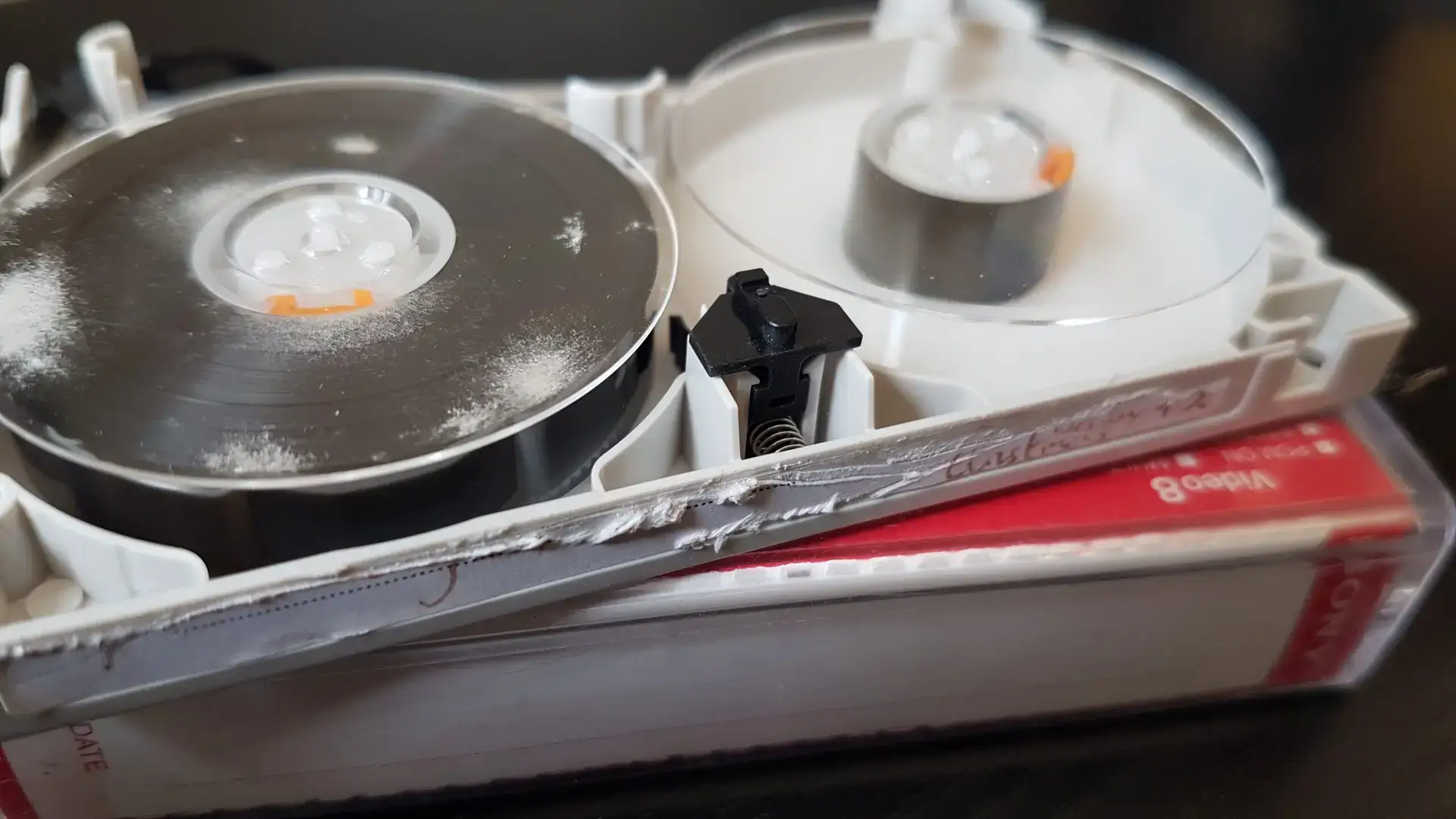
Mould can appear as fuzzy or powdery patches in white, brown, black, green or other colours. You may see growth on the cassette case, around the windows or along the exposed edges of the tape pack.
A mouldy case does not necessarily mean that the tape itself has escaped damage, but it provides a reason to inspect the cassette carefully. Mould can move between the case and tape, and growth can occur between tightly wound layers where you cannot easily see it.
The University of Illinois Preservation Self-Assessment Program recommends looking through the cassette windows and checking the tape edges for fuzzy growth or discolouration. It also advises treating mouldy tapes as a preservation concern rather than simply putting them into a player to see whether they still work.
Signs that an audio cassette may have mould
| What you notice | What it may indicate | Recommended response |
|---|---|---|
| Fuzzy patches on the case | Possible mould contamination | Isolate the cassette |
| White, brown, black or green growth near the tape | Mould may have reached the tape | Do not play it |
| Growth along the tape edge | Possible contamination within the tape pack | Seek specialist advice |
| Musty or damp storage environment | Conditions that may encourage mould | Check nearby tapes |
| Several affected cassettes | Wider storage or environmental problem | Quarantine affected media |
Mould can affect more than the cassette you can see. If several tapes have shared the same damp storage conditions, inspect the wider collection rather than assuming the problem affects only one item.
Why Does Mould Grow on Cassette Tapes?
Mould thrives when environmental conditions provide sufficient moisture and warmth. Poorly ventilated storage areas, damp rooms, garages, lofts and other locations with fluctuating humidity can create favourable conditions.
The tape itself contains organic components that can support contamination, while dust and dirt can provide additional material for mould growth.
The National Archives of the United States advises storing magnetic tape at controlled humidity and notes that higher humidity can encourage mould growth. It also recommends separating deteriorating magnetic media from other archival material.
This means mould often points to a storage problem as well as a tape problem.
If you find mould on one cassette, consider where you stored the collection and whether other tapes could have experienced the same conditions.
Should You Play a Mouldy Audio Cassette?
No. Do not play a cassette that you suspect contains mould.
A cassette player pulls the tape across several mechanical components, including the heads, guides and capstan. Mould and debris can transfer onto those components during playback.
That creates two risks. First, the contaminated cassette may suffer further damage. Secondly, mould and debris can contaminate the playback equipment and potentially spread to other tapes.
The University of Illinois specifically advises against playing mouldy tapes because contamination can enter playback machinery and affect other tapes.
The Canadian Conservation Institute also advises against playing mouldy tapes and recommends separating affected tapes from the rest of a collection.
So if your first thought is “I’ll just put it in the cassette player to see if it works”, resist that temptation.
Can You Clean Mould Off an Audio Cassette Yourself?
For a valuable or irreplaceable recording, professional treatment is the safer option.
Magnetic tape needs specialised handling because the recorded information sits on the tape surface. Cleaning the cassette shell is not the same as cleaning the magnetic tape, and inappropriate physical contact or chemicals can damage the recording.
The Library of Congress states that cleaning magnetic tape is a delicate process that preservation specialists should undertake.
The Canadian Conservation Institute similarly advises that most people should not attempt to clean mould from audiotapes and recommends using experienced conservation professionals.
Avoid these common DIY mistakes
Do not:
- Wipe the magnetic tape with a damp cloth.
- Spray household disinfectant onto the cassette.
- Apply bleach or general-purpose mould cleaner.
- Scrub visible growth from the tape.
- Put the cassette into an oven or domestic heater.
- Freeze the cassette as a home treatment.
- Run the cassette through a player to remove the mould.
- Clean the tape without understanding its physical condition.
Different types of tape deterioration require different approaches. A treatment that helps one type of magnetic media may damage another.
What Should You Do If You Find Mould on Your Cassettes?
Start with isolation rather than cleaning.
1. Stop handling the cassette unnecessarily
Avoid touching visible mould and do not repeatedly open the cassette shell. If you need to inspect it, minimise handling and avoid disturbing the growth.
2. Separate the affected tape
Keep the suspected mouldy cassette away from unaffected recordings. If several tapes show signs of contamination, separate the affected group from the rest of your collection.
3. Do not test the recording
You do not need to know whether the cassette still plays before seeking advice. Playback could spread contamination and create additional mechanical problems.
4. Consider the importance of the recording
A cassette containing an ordinary commercial recording presents a different preservation priority from one containing a parent’s voice, a family interview or a unique historical recording.
Prioritise anything that you cannot replace.
5. Arrange an assessment
A specialist can determine whether the problem affects the cassette shell, tape surface, tape pack or playback mechanism and decide whether recovery remains practical.
Can Mould Permanently Damage an Audio Cassette?
Yes. Mould can cause physical problems within the tape pack and may affect the recorded surface.
When mould grows between tightly wound layers, it can cause adjacent layers to stick together. Attempting to wind or play contaminated tape can then create additional stress and potentially damage the tape.
Mould can also affect the magnetic layer itself. If the recorded surface suffers physical damage, some of the original signal may no longer remain recoverable.
This makes early intervention important. Cleaning mould does not necessarily restore information that the mould has already damaged.
In other words, removing visible mould and recovering the recording are two different tasks.
How Do Professionals Recover Mouldy Audio Tapes?
A professional recovery process begins with assessment rather than immediately putting the cassette into a player.
A specialist may consider:
- The extent of mould contamination.
- The condition of the cassette shell.
- The condition of the tape pack.
- Whether the tape shows signs of sticking or other deterioration.
- Whether the tape can safely travel through suitable playback equipment.
- Whether cleaning or other preparation is necessary.
- How to capture the recording while minimising further stress.
The Canadian Conservation Institute notes that heavily contaminated tapes and tapes with mould require professional cleaning using specialised equipment. It also explains that physically or chemically damaged tapes may need treatment before playback.
The specialist’s objective should not simply be to make the cassette look clean. The real goal is to recover the recorded information without causing unnecessary additional damage.
Does Cleaning Mould Mean the Cassette Is Safe to Play?
Not automatically.
A cassette may look much cleaner after treatment while still having underlying problems. Mould can affect the tape pack, and previous exposure to poor storage conditions may have contributed to other forms of deterioration.
A specialist should therefore consider the entire condition of the cassette rather than treating visible mould as an isolated cosmetic problem.
This distinction matters because an apparently clean cassette can still have a fragile or compromised magnetic surface.
What About the Cassette Case?
The cassette shell and its case can both carry mould contamination.
The Preservation Self-Assessment Program recommends clean protective housings and notes that a dirty or mouldy container can indicate a wider preservation problem. Where necessary, the housing may need replacement rather than simply putting the contaminated cassette back into the same environment.
After professional assessment, the cassette may therefore need:
- A clean protective case
- Replacement of a badly damaged housing
- Attention to mechanical components
- Appropriate storage away from affected media
- A controlled environment with stable conditions
Keeping a cleaned cassette in a damp cupboard simply recreates the conditions that encouraged the mould in the first place.
How Should You Store Audio Cassettes to Prevent Mould?
Prevention starts with the storage environment.
Keep important cassette recordings in a clean, dry and stable indoor environment. Avoid places that experience significant temperature or humidity changes.
Better storage practices
- Keep cassettes away from damp.
- Avoid garages, sheds and poorly controlled loft spaces.
- Protect tapes from dust and contamination.
- Keep storage areas reasonably stable rather than allowing large environmental fluctuations.
- Use suitable protective cases.
- Keep suspected mouldy media away from unaffected collections.
- Check the condition of tapes periodically.
The National Archives recommends controlled conditions for magnetic media and highlights the relationship between humidity, mould and tape deterioration.
Good storage cannot reverse existing mould, but it can reduce the chance of the problem continuing or returning.
Should You Digitise Mouldy Cassettes?
If the recording matters, digitisation can protect the content from the need for repeated playback of the original cassette.
However, digitisation does not replace the need to assess mould first. A contaminated cassette may require preparation before a specialist can safely play it.
Once the tape has reached a suitable condition for playback, creating a digital master gives you an accessible copy of the recording and reduces the need to rely on the original cassette for everyday listening.
For family recordings, interviews and other unique material, professional cassette conversion can form part of a wider preservation strategy.
Keep the original cassette where practical. The original remains the physical source recording and may contain historical information that a digital copy cannot reproduce.
What If You Have Several Mouldy Audio Tapes?
Treat the collection as a group rather than simply cleaning the worst-looking cassette.
If several tapes have lived in the same box, cupboard, loft or other environment, inspect them all. One mouldy cassette may indicate that the storage conditions affected the wider collection.
Use this checklist:
- Separate visibly affected tapes.
- Avoid playing any suspected mouldy tape.
- Identify recordings with irreplaceable content.
- Check cases and tape edges for visible contamination.
- Consider the storage conditions that caused the problem.
- Do not experiment with household cleaning products.
- Ask a specialist about treatment before attempting playback.
- Prioritise unique recordings for recovery and digitisation.
- Improve storage conditions after treatment.
This approach helps you protect both the individual recordings and the rest of the collection.
Can You Recover the Sound From a Mouldy Cassette?
Often, the answer depends on how far the mould has progressed and whether it has damaged the magnetic recording.
A cassette with contamination confined largely to its housing may present a very different recovery challenge from one where mould has penetrated the tape pack or damaged the recording surface.
No responsible specialist should promise that every mouldy cassette will produce a perfect digital copy.
The possible outcomes include:
| Condition | Possible outcome |
|---|---|
| Mould mainly affecting the case | Cleaning and suitable rehousing may resolve the immediate contamination |
| Light contamination on the tape | Specialist cleaning may allow playback and digitisation |
| Mould throughout the tape pack | Recovery may require more extensive specialist treatment |
| Tape layers sticking together | Playback may cause further damage and requires careful assessment |
| Damaged magnetic surface | Some audio information may already be lost |
| Severe physical deterioration | Recovery may only be partial or impossible |
The condition of the recording matters more than how dramatic the mould looks from outside.
Common Questions About Mouldy Audio Tapes
Is mould on a cassette dangerous?
Mould can present health risks, particularly for people who are sensitive to mould or who disturb contaminated material. Avoid unnecessary handling and do not deliberately brush or shake mould from the cassette. Specialist facilities can use appropriate containment and protective procedures.
Can I use alcohol to clean a mouldy cassette?
Do not assume that alcohol is safe for the magnetic tape. The Library of Congress advises that magnetic-tape cleaning requires specialist knowledge and careful procedures.
Can I freeze a mouldy cassette?
Freezing is not a suitable DIY solution for magnetic audio tape. The Canadian Conservation Institute specifically warns that freezing can damage magnetic recordings and may affect the relationship between the lubricant and magnetic-particle binder.
Should I throw away a mouldy cassette?
Not necessarily. If the recording contains important or irreplaceable material, professional assessment may determine that recovery remains possible. Throwing the cassette away removes any remaining opportunity to recover its contents.
Can mould spread to other cassette tapes?
Yes. Mould can spread between contaminated media and storage materials, which is why preservation guidance recommends isolating affected tapes.
Is it better to clean a cassette or digitise it?
For an important recording, you need to address the mould before safe playback. Cleaning and digitisation therefore form separate stages of preservation: first make the recording suitable for safe recovery, then capture the audio digitally.
Preserve Mouldy Audio Tapes Before the Recording Becomes Unrecoverable
Mouldy audio tapes deserve careful treatment, particularly when they contain voices, interviews, family memories or recordings that exist nowhere else. The safest approach involves isolating the affected cassette, avoiding unnecessary playback and seeking appropriate specialist advice rather than experimenting with household cleaning methods.
Once professionals establish that the tape can undergo safe playback, digitisation can give you convenient access to the recording while reducing your reliance on the original cassette. Good storage then helps protect both the original and the digital copies for the future.
For additional guidance, preserving audio recordings for the long term should form part of the wider approach rather than treating digitisation as the only preservation step.
Ultimately, when valuable recordings need careful handling, it makes sense to choose a professional company with years of experience dealing with delicate media, such as Supaphoto Ltd.