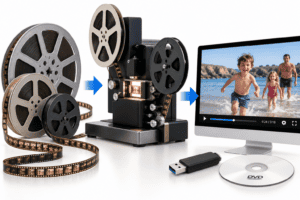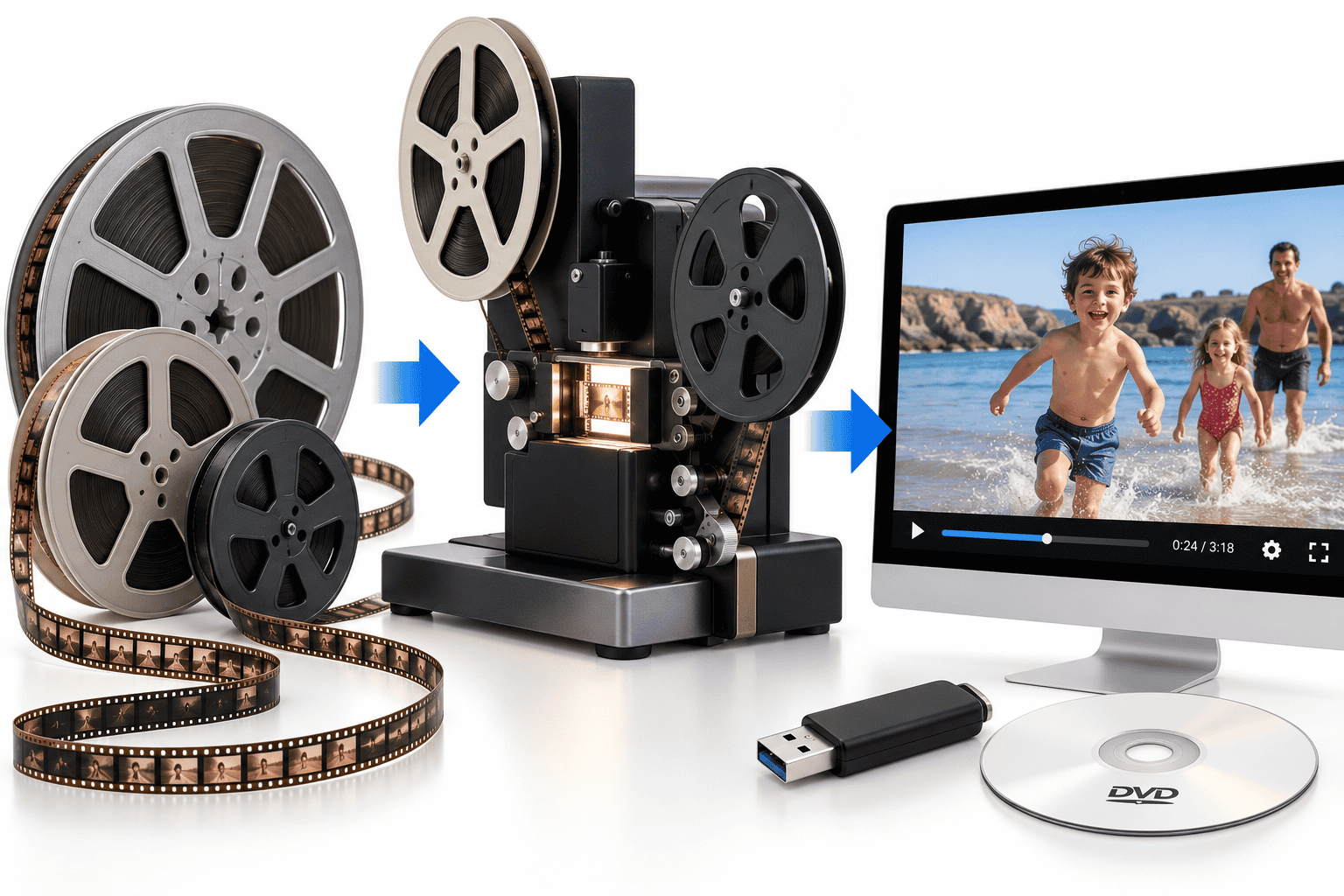

The cost of cine film conversion depends mainly on how much film you have, its gauge and condition, whether it carries sound, the scanning quality you choose and how you want the finished files supplied. Reel diameter gives a useful first estimate, but two apparently identical reels may contain different lengths of film.
| Cost factor | Why it matters |
|---|---|
| Reel size | Larger reels normally contain more film and take longer to scan |
| Film gauge | 8mm, Super 8, 9.5mm and 16mm require different equipment |
| Amount of film | A partially filled reel may contain much less footage than its capacity |
| Sound | Magnetic or optical sound requires additional capture equipment |
| Film condition | Broken splices, dirt and damaged perforations can require preparation |
| Scan resolution | Higher-resolution scans generate more data and processing |
| Restoration | Colour correction, stabilisation and cleaning add work |
| Output format | MP4, ProRes, USB and other options can affect processing and storage |
The best way to compare quotes is therefore to understand exactly what each provider includes rather than choosing the lowest headline price.
Reel Diameter Gives You a Useful Starting Point
Most family cine collections contain several different reel sizes.
For 8mm and Super 8, common examples include:
- 3-inch reel – typically up to around 50 feet
- 5-inch reel – typically up to around 200 feet
- 7-inch reel – typically up to around 400 feet
That means a full 7-inch reel can contain roughly eight times as much film as a full 3-inch reel.
It will consequently take much longer to scan.
Reel size is therefore one of the easiest ways to estimate the scale of a cine collection before sending it away.
However, measure the diameter of the reel, not the metal film can that surrounds it.
A large storage tin may contain a much smaller reel.
A Large Reel Isn’t Necessarily Full
This is one of the most important details when estimating cine conversion costs.
A 7-inch reel has the capacity to hold considerably more film than a 3-inch reel, but it may contain only a small amount.
Families often joined several short films onto larger reels after processing so they could watch an entire holiday or year of home movies without repeatedly changing reels.
You might therefore find:
- a completely full 7-inch reel
- a 7-inch reel that is half full
- several 3-inch reels joined onto one large reel
- a large reel containing only a few minutes of footage
This is why different companies use different pricing methods.
Some charge according to reel diameter. Others measure the actual amount of film.
When comparing quotations, establish which method applies.
How Long Is a Cine Reel?
Running time depends on film gauge and projection speed, so there is no exact duration based solely on reel diameter.
For typical amateur 8mm-family film, a useful approximate guide is:
| Reel | Approximate film capacity | Typical approximate running time |
|---|---|---|
| 3-inch | 50 ft | 3–4 minutes |
| 5-inch | 200 ft | 13–17 minutes |
| 7-inch | 400 ft | 27–33 minutes |
The variation occurs because Standard 8 and Super 8 were commonly projected at different frame rates.
Silent Standard 8 often ran at around 16 frames per second, while Super 8 commonly used 18 fps. Sound Super 8 was frequently recorded at 24 fps.
At a faster frame rate, the same physical length of film plays for less time.
This matters if a company charges by running minute rather than by footage or reel.
Film Gauge Can Affect the Price
The word “cine film” covers several formats.
UK family collections may contain:
- Standard 8mm
- Super 8
- 9.5mm
- 16mm
The BFI National Archive identifies film gauge by measuring the physical width of the film and lists 8mm, 9.5mm and 16mm among the gauges held in its collections. The BFI’s archive guidance explains film-gauge identification.
Standard 8 and Super 8 are both 8mm wide, but their frame and perforation arrangements differ.
sometimes called Regular 8 or Double 8, has relatively large sprocket holes and a smaller image area.
Super 8
Super 8 uses smaller perforations, which leaves more of the film width available for the picture.
9.5mm
9.5mm film has a distinctive perforation positioned between frames near the centre of the strip.
The BFI notes that this arrangement allowed 9.5mm to use an unusually large image area for its width. Its history of 9.5mm film explains why the format produced such a substantial image area.
16mm
16mm film is twice the physical width of 8mm and may require different scanning gates and handling.
Specialist or less common gauges can therefore attract different charges even when the reel diameter appears similar.
Standard 8 and Super 8 Shouldn’t Automatically Cost Differently
For many modern scanning systems, Standard 8 and Super 8 can use the same overall scanning platform with the appropriate film gate or configuration.
So the fact that one film is Super 8 does not automatically mean it should cost dramatically more than Standard 8.
What usually matters more is:
- footage
- condition
- sound
- scanning resolution
- additional restoration
If two providers quote very different prices, compare what they actually supply rather than assuming one uses better equipment purely because the headline figure is higher.
Sound Can Affect Cine Film Conversion Costs
Most amateur cine film is silent, but some Super 8 and 16mm material contains sound.
Look for a narrow brown, bronze or dark magnetic stripe running along the edge of the film.
Some films may contain:
- magnetic soundtrack
- optical soundtrack
- separate audio recording
Sound capture requires compatible equipment and synchronisation with the scanned picture.
Providers may therefore:
- include sound in the standard price
- charge an additional fee
- price sound reels separately
If you know that a family film contains voices, music or narration, confirm that sound capture is included before accepting a quotation.
Otherwise you could receive an excellent picture scan with the original soundtrack missing.
Why Film Condition Can Increase the Work
Old cine film can survive remarkably well, but not every reel arrives ready for scanning.
A technician may encounter:
- broken splices
- dried adhesive
- damaged perforations
- curled film
- loose film
- torn leaders
- dirt
- dust
- mould
- incorrect winding
- brittle sections
Minor preparation may form part of a standard service.
More serious repair or cleaning can require additional work.
Do not attempt to clean valuable cine film with household cleaners or solvents.
The Library of Congress recommends cool, dry, stable storage for motion-picture film and highlights the sensitivity of photographic film to environmental conditions. Its guidance on caring for motion-picture film explains appropriate handling and storage.
Frame-by-Frame Scanning Is Different From Filming a Projector Screen
The transfer method also affects what you are paying for.
A simple historical approach involved projecting the cine image and recording the screen with a video camera.
That can introduce:
- flicker
- hotspots
- distorted geometry
- uneven brightness
- reduced sharpness
- visible screen texture
Modern specialist systems can instead scan the film frame by frame.
Each individual cine frame is captured directly rather than photographed from a projected image.
This gives the digitisation process much greater control over:
- framing
- exposure
- colour
- focus
- image stability
When comparing quotes, ask how the film will actually be captured.
The phrase “cine transfer” does not by itself explain the process.
Does 4K Cine Scanning Always Look Better Than 2K?
Not necessarily.
Higher-resolution capture gives you more pixels, but the amount of genuine detail available depends on:
- film gauge
- original camera lens
- camera focus
- film stock
- exposure
- grain
- condition
An out-of-focus Super 8 recording does not become sharp simply because someone scans it at 4K.
Likewise, a badly underexposed film cannot reveal unlimited shadow detail.
Higher resolution becomes particularly useful when you want to:
- preserve a strong master file
- crop the picture
- carry out restoration
- produce larger displays
- retain as much of the original film information as practical
For ordinary family viewing, other factors such as good exposure, colour correction and stable capture can sometimes make a more visible difference.
Colour Correction and Restoration Are Different From Scanning
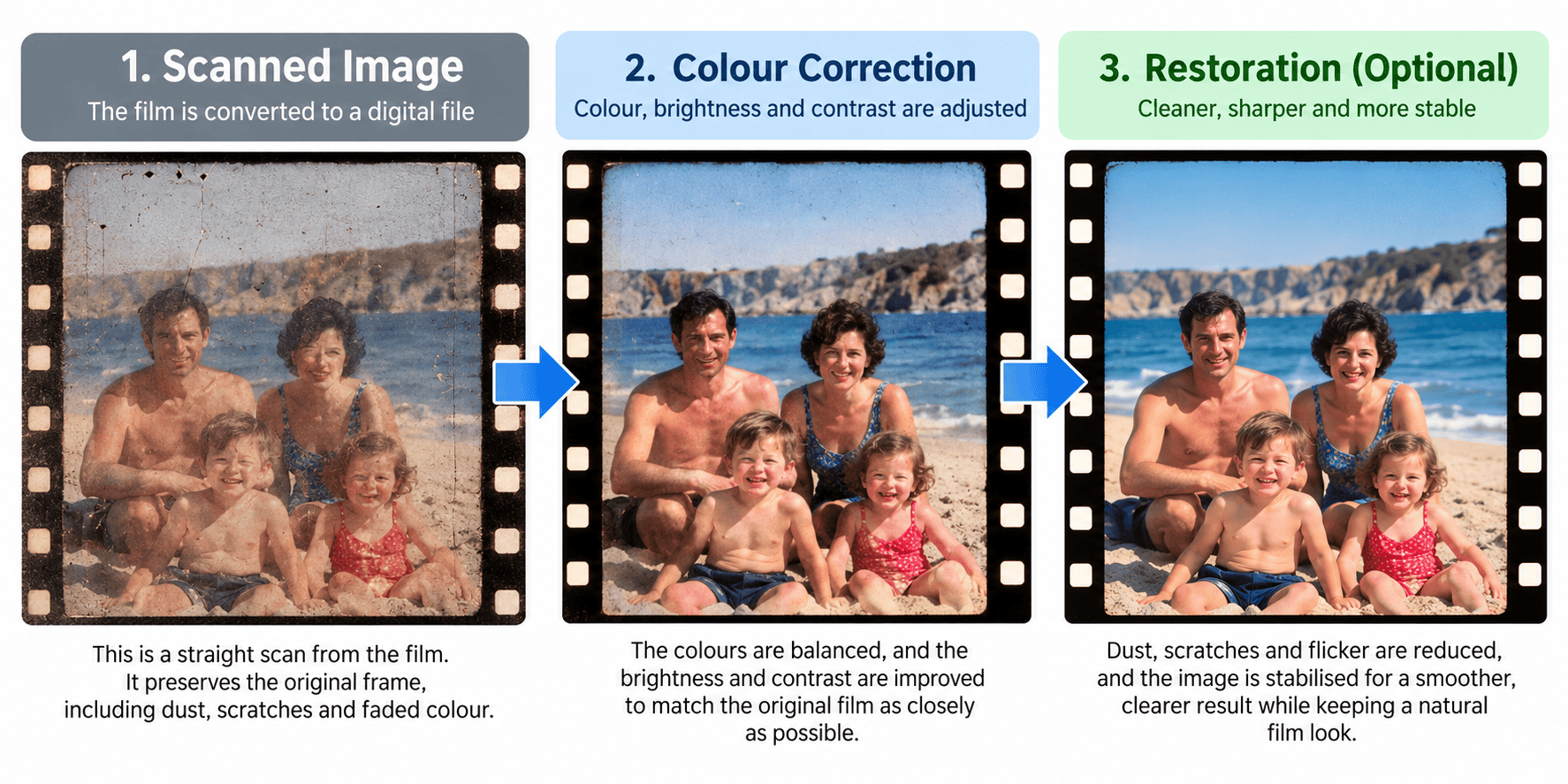
Basic scanning captures the film.
Restoration changes or improves the digital result afterwards.
Possible restoration work includes:
- correcting colour casts
- adjusting brightness
- improving contrast
- stabilising movement
- reducing visible dirt
- repairing individual damage
- careful sharpening
- reducing flicker
Not every film needs extensive restoration.
Some well-preserved Kodachrome and other reversal films can still look remarkably strong decades after processing.
For preservation, retain a clean digital master before applying substantial enhancement.
That gives you the option to revisit the material later without relying solely on today’s restoration choices.
MP4, ProRes or Another Output Format?
The digital file format you choose can affect both cost and storage.
MP4
MP4 using a modern codec such as H.264 is useful for:
- televisions
- computers
- phones
- tablets
- sharing with relatives
- everyday playback
It provides relatively compact files and excellent compatibility.
Higher-Quality Master Files
Formats such as ProRes may be useful when you intend to:
- edit the film
- perform significant restoration
- retain a higher-quality archive master
- work professionally with the footage
These files can be much larger.
You therefore need to consider not only the price of scanning but also how much digital storage the collection will require.
A specialist service for scanning old cine reels into modern digital files can provide practical viewing copies while retaining higher-quality output where the collection warrants it.
USB, Download or Hard Drive?
Delivery method can also alter the final price.
Possible options include:
- digital download
- USB memory stick
- external hard drive
- customer-supplied drive
- DVD
For a small collection, downloading files may be straightforward.
For a substantial cine archive, the files may become too large for convenient online delivery.
Check whether the quoted price includes:
- storage media
- postage
- file transfer
- additional copies
- cloud access
A cheap headline scanning price can become less attractive if every practical output option carries an additional charge.
Why DVD Shouldn’t Be Your Only Copy
DVD remains useful for people who prefer conventional disc playback.
However, it is less flexible than keeping the underlying digital files.
MP4 or master files can be:
- backed up easily
- copied to another drive
- stored in the cloud
- shared with relatives
- edited
- migrated to future storage
If you want DVDs, consider having them as additional viewing copies rather than the only digital output.
How to Compare Cine Film Conversion Quotes Properly
Before deciding which quotation offers the best value, check these points:
- Is pricing per reel, foot or minute?
- Is VAT included?
- What scan resolution is supplied?
- Is sound capture included?
- Are broken splices repaired?
- Does the service include basic cleaning?
- Is colour correction included?
- What digital file format will you receive?
- Is the USB or drive included?
- Are your original reels returned?
- Does the provider check the completed files?
- Are there additional charges for unusually large reels?
Two prices that initially appear miles apart may become much closer once you compare exactly what each service includes.
Should You Combine Small Reels Before Sending Them?
Usually, no.
Leave the collection in its existing order.
Labels, boxes and reel sequences can contain valuable information about:
- dates
- holidays
- family members
- events
- locations
Joining films yourself risks changing their order or damaging old splices.
Instead, number the reels and record whatever appears on the original boxes.
For example:
Box 1 – Reel 01 – Cornwall 1968
Box 1 – Reel 02 – Christmas 1969
This also makes it much easier to match the resulting digital files back to the physical originals.
Frequently Asked Questions About Cine Film Conversion Costs
How much film is on a 3-inch cine reel?
A typical 3-inch 8mm or Super 8 reel can hold around 50 feet of film, usually providing roughly three to four minutes of footage depending on frame rate.
How much is on a 5-inch reel?
A typical 5-inch reel can hold around 200 feet, giving approximately 13 to 17 minutes depending on the format and projection speed.
How much film fits a 7-inch reel?
A full 7-inch 8mm-family reel can hold around 400 feet, often representing roughly 27 to 33 minutes of footage.
Does Super 8 cost more than Standard 8?
Not necessarily.
Both formats are 8mm wide, and many services price them similarly. Footage, sound, resolution and condition may have a greater effect on cost.
Does Super 8 have sound?
Some Super 8 does.
Look for a narrow magnetic stripe along the edge of the film. Many Super 8 home movies remain silent.
Is 4K necessary for Super 8?
Not for every project.
A good 2K or high-quality HD scan can be perfectly suitable for many family films, while higher resolution provides additional flexibility for archiving, cropping and restoration.
Should I keep the original reels after scanning?
Yes.
Digital files make viewing and sharing much easier, but the cine film remains the original photographic source. Store it carefully after digitisation.
Understanding the Quote Matters More Than Finding the Cheapest Number
The cost of cine film conversion makes more sense once you understand what sits behind it. A 3-inch reel and a full 7-inch reel do not contain the same amount of film, while sound, damaged splices, high-resolution scanning, restoration and large master files can all add work.
Compare providers on what they actually capture and supply, not merely the cheapest advertised reel price. For a few straightforward reels, several approaches can work well. For large, fragile or historically important collections, it ultimately makes sense to choose an experienced professional company accustomed to handling different cine gauges and reel conditions, such as Supaphoto Ltd.