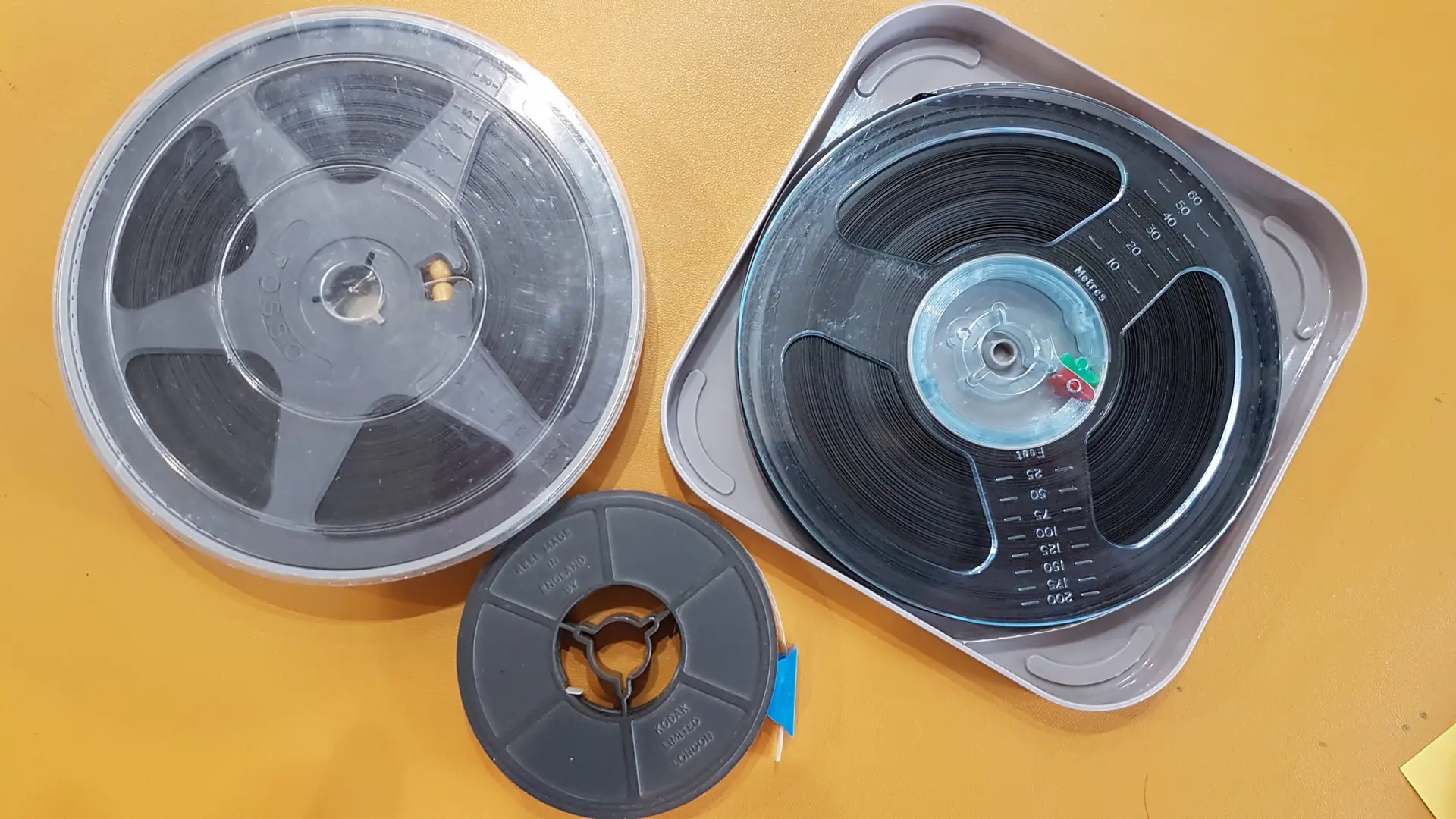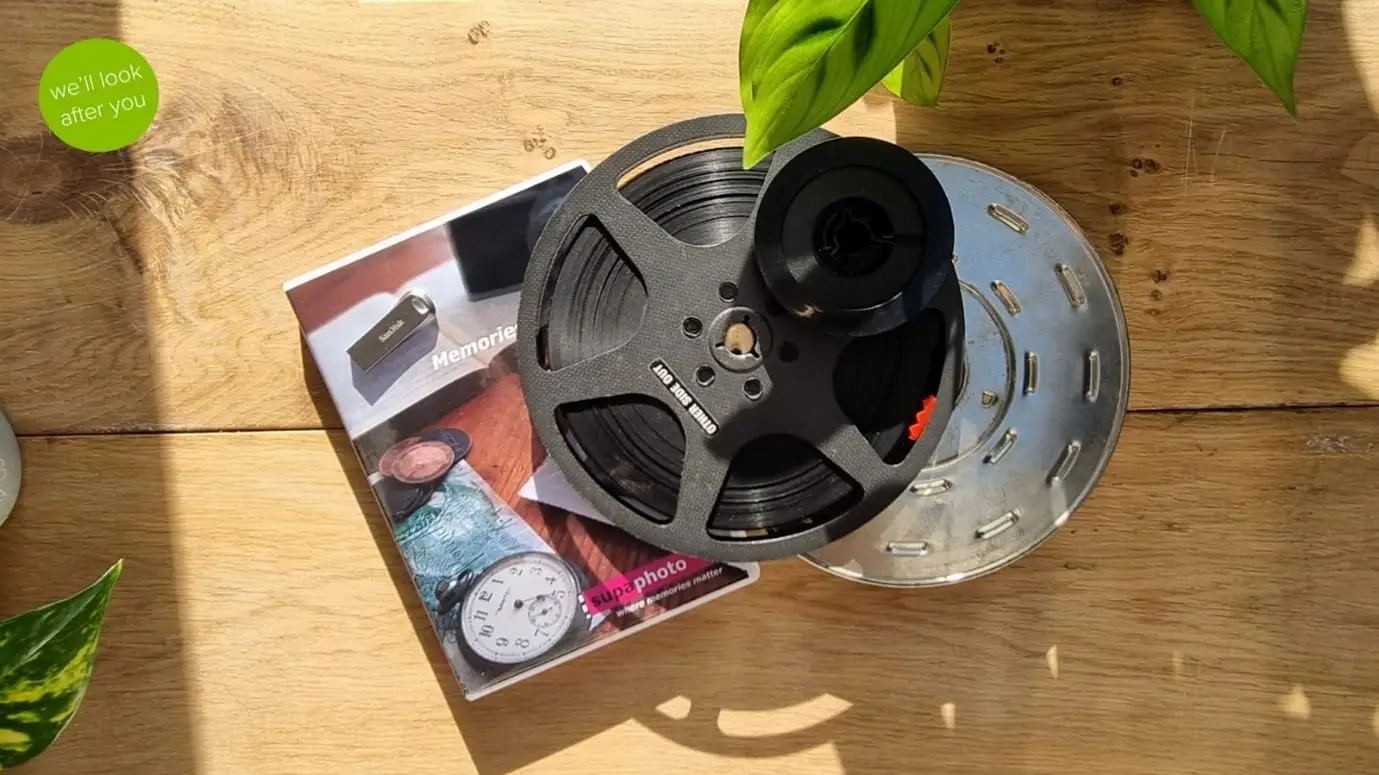

The easiest way to tell 8mm film from Super 8 film is to examine the sprocket holes. Standard 8 has relatively large perforations positioned between the picture frames, while Super 8 has much smaller perforations positioned alongside the centre of each frame. Both films are approximately 8mm wide, so width alone won’t identify them. National Archives

| Feature | Standard 8 / Regular 8 | Super 8 |
|---|---|---|
| Film width | 8mm | 8mm |
| Sprocket holes | Larger | Noticeably smaller |
| Hole position | Between frames | Alongside centre of frame |
| Picture area | Smaller | Larger |
| Introduced | 1930s | 1965 |
| Original camera loading | Double-run film on a spool | Light-proof cartridge |
| Sound | Usually silent | Some films have a sound stripe |
Why Are 8mm and Super 8 So Easy to Confuse?
The confusion is understandable because Standard 8 and Super 8 are both 8mm-wide cine films. Putting two wound reels side by side therefore doesn’t necessarily make their format obvious.
Standard 8 is also known as Regular 8, Normal 8 or Double 8. The US National Archives identifies film gauge—the width and perforation arrangement—as a primary characteristic used to identify motion-picture film. Its guidance confirms that Super 8 is also 8mm wide but uses smaller perforations, leaving more room for the image. National Archives
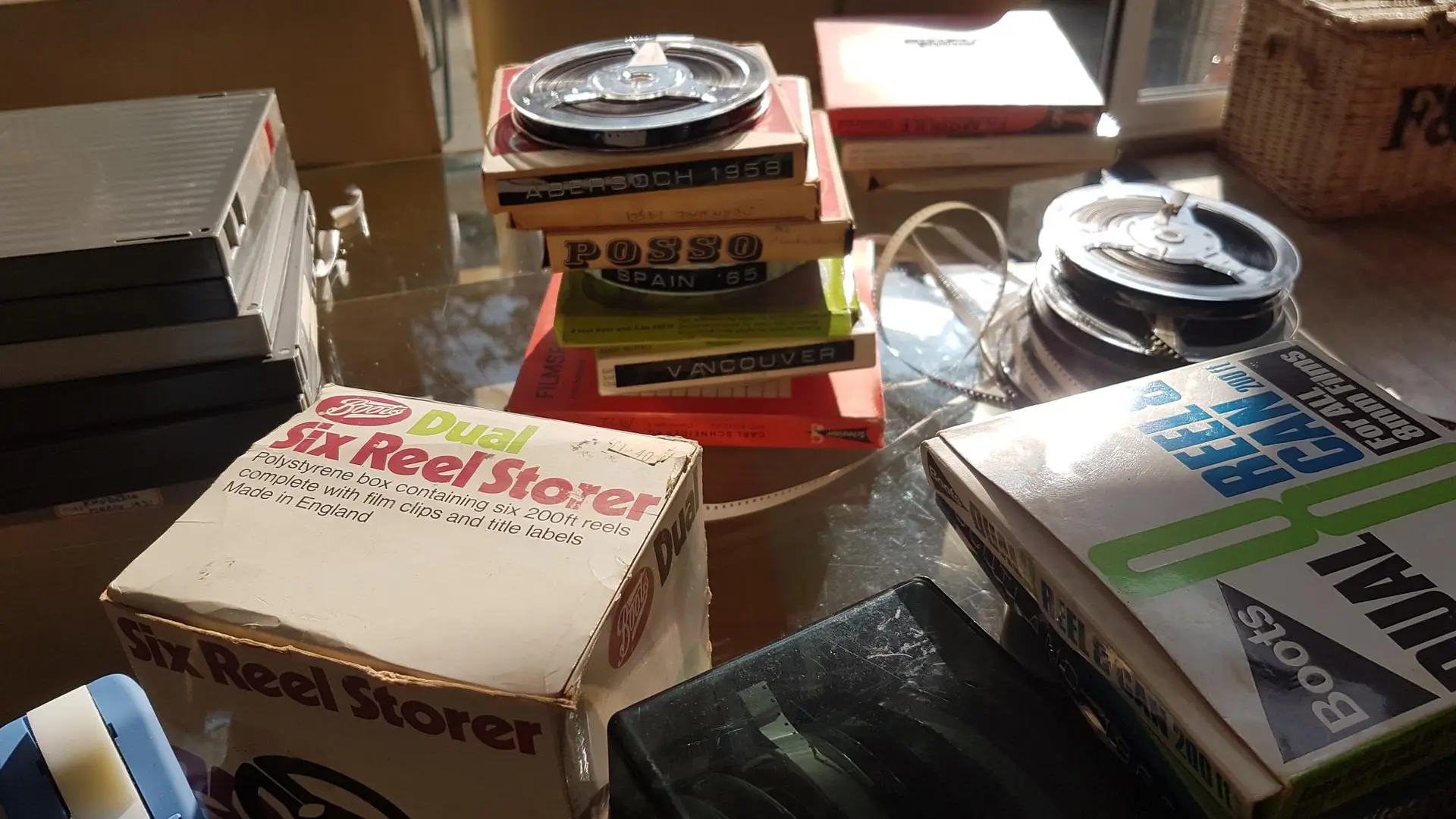
The names on old boxes can add to the confusion. A reel simply labelled “8mm” isn’t necessarily Super 8, and films may have been moved onto different reels during their lifetime.
For that reason, inspect the film itself rather than relying exclusively on the reel, box or handwritten label.
Check the Sprocket Holes First
This is the quickest and most reliable visual check you can make at home.
Carefully unwind just enough film to see several frames and hold it towards a light source without touching the picture area.
Standard 8 Film
On Standard 8, the sprocket holes are comparatively large. They sit approximately alongside the dividing line between one picture frame and the next.
Because these perforations occupy more of the film’s width, there is less room available for the picture.
Super 8 Film
Super 8 uses considerably smaller sprocket holes. Instead of sitting between the frames, each perforation is positioned approximately alongside the centre of an individual picture frame.
The Science Museum Group explains that Super 8 retained the same 8mm film width but reduced the dimensions of the perforations, allowing a greater area to be used for the image. Science Museum Group Collection
Once you’ve seen the two formats together, the difference can become surprisingly easy to recognise.
Does Super 8 Have a Larger Picture Than Standard 8?
Yes. Super 8 provides a larger image area even though the film itself remains the same width.
This was one of the format’s important improvements.
Rather than making the film wider, the Super 8 system made the sprocket holes smaller. The space saved could therefore be used for a larger picture frame. The US National Archives specifically identifies the smaller perforations as the feature that permits the larger Super 8 image area. National Archives
This is another useful identification clue.
Hold a short section of film towards a light source and look at the pictures themselves. If the image appears to occupy more of the available film area and the sprocket holes look relatively small, you are probably looking at Super 8.
With Standard 8, the larger perforations are much more prominent in relation to the picture.
When Was Super 8 Introduced?
Super 8 was launched by Kodak in 1965.
The Science Museum Group records its launch in May 1965 and describes the format’s light-proof plastic cartridge containing 50 feet (15 metres) of film. Science Museum Group Collection
The date of your family films can therefore provide a useful clue.
If you’re confident that a film was shot in the 1940s or 1950s, it cannot be Super 8. If it was shot considerably later, Super 8 becomes more likely.
Don’t rely on dates alone, though. Older camera formats didn’t instantly disappear when a new format was introduced. Families continued using equipment they already owned.
Treat the date as supporting evidence and the film perforations as the stronger identifier.
What Does “Double 8” Mean?
If you’ve found an old box marked Double 8, you’re dealing with the system that ultimately produced Standard 8 film.
The original camera film started as a wider strip. Kodak’s 8mm system used 16mm-wide film that was exposed along one side, turned over in the camera and exposed along the other. After processing, the laboratory slit it lengthways and joined the resulting strips to create the finished 8mm film. Kodak introduced this system in 1932. Kodak Shop
This explains several names you may encounter:
- Standard 8
- Regular 8
- Normal 8
- Double 8
- Double-run 8mm
- 8mm cine film
They generally refer to the older 8mm system rather than Super 8.
Don’t confuse Double 8 with a film that is 16mm wide when you receive it back from processing. The finished projection film is 8mm wide.
Why Was Super 8 Developed?
Home cine filming needed to become easier.
Standard 8 worked extremely well for generations of amateur filmmakers, but loading and handling film required more involvement from the user.
Super 8 introduced a convenient cartridge system. Instead of manually loading an open spool and turning it over during filming, the user inserted a light-proof cartridge into a compatible camera.
The Science Museum Group notes that the cartridge made the format easier to load, while its smaller perforations increased the available picture area. Science Museum Group Collection
These two changes help explain why Super 8 became such an important home-movie format:
- easier camera loading;
- larger picture area;
- compact 8mm-wide film;
- straightforward amateur use.
For anyone sorting inherited family films today, that means collections dating across several decades can quite easily contain both Standard 8 and Super 8 reels.
Can the Reel Tell Me Which Film I Have?
It can provide clues, but don’t identify cine film from the reel alone.
Films can be rewound onto replacement reels. A reel originally intended for one format may therefore contain something different today.
Packaging can be useful if you’re confident that it’s original. Labels mentioning Super 8 obviously provide a strong clue, while older packaging marked Double 8 points towards Standard 8.
However, decades-old family collections are often mixed up. Films get transferred between boxes, handwritten labels become detached and reels are reused.
Use this order when identifying a mystery film:
- Inspect the film width.
- Examine the sprocket holes.
- Look at the position and size of the frames.
- Check for a sound stripe.
- Consider the date and original packaging.
- Use the reel type only as additional evidence.
That reduces the chance of identifying a film incorrectly because it happens to be sitting on the wrong reel.
Does Super 8 Film Have Sound?
Some Super 8 films have sound, but many are silent.
A magnetic sound recording can appear as a narrow stripe running along the edge of compatible Super 8 film. If you see a brownish stripe running continuously beside the picture area, it may indicate a sound recording.
Don’t assume every stripe or discolouration is sound, however.
Likewise, the absence of a stripe doesn’t mean the film isn’t Super 8. A huge number of family Super 8 movies were shot silently.
If you’re planning to have old reels digitised, mention any apparent soundtracks. The transfer process needs to capture the audio as well as the picture where usable sound is present.
This can be particularly important with family films because speech, music and background sounds may contain memories that aren’t apparent simply by looking at individual frames.
Can You Play Standard 8 Film on a Super 8 Projector?
Not necessarily.
Although both formats are 8mm wide, their perforation dimensions, frame position and projection requirements differ.
Putting unidentified old film through an unsuitable projector isn’t a good identification method. A projector that has been stored for decades may itself have deteriorated belts, rollers or other components capable of damaging film.
There were dual-format projectors designed to accommodate both Standard 8 and Super 8, but that doesn’t mean every Super 8 projector can safely play Standard 8.
If you simply want to identify a reel, examine the film visually. You don’t need to project it.
This is particularly sensible if the reel contains an irreplaceable family recording.
What If the Film Is Neither Standard 8 nor Super 8?
Don’t assume every small cine reel contains one of these two formats.
Family collections can include other gauges, particularly 9.5mm and 16mm film.
The US National Archives notes that film gauge is one of the primary ways motion-picture material is classified and lists 8mm, 16mm and 35mm among common gauges. National Archives
A ruler can quickly help.
If the strip is substantially wider than 8mm, you’re dealing with another format. With 9.5mm film, another distinctive clue is the position of the perforations: they’re located centrally between frames rather than conventionally along one edge.
If you’re uncertain, don’t put the film through a projector to find out. A specialist can usually identify the gauge from the physical film.
How Should You Handle an Old Cine Reel?
Treat an unknown reel as irreplaceable until you know otherwise.
Hold film by its edges where practical and avoid touching the picture area unnecessarily. Don’t pull tightly wound film from the reel or attempt to straighten brittle material aggressively.
Before projection or digitisation, look for:
- broken or weak splices;
- torn sprocket holes;
- curled film;
- brittle sections;
- loose leaders;
- dirt or deposits;
- unusual odours;
- damaged reels;
- badly wound sections.
The US National Archives’ guidance for identifying motion-picture formats also distinguishes film bases and deterioration characteristics, which can matter when dealing with older archive collections.
If a film appears badly deteriorated, stop handling it unnecessarily and seek specialist advice.
Is It Better to Project Old Cine Film or Digitise It?
If your primary objective is to watch and preserve family footage, digitisation usually provides the more practical long-term solution.
Projection requires the physical film to travel repeatedly through mechanical equipment. A digital copy allows you to watch the footage without repeatedly handling the original reel.
Modern cine transfer equipment can capture individual film frames directly rather than simply recording an image projected onto a wall. Depending on the transfer system and condition of the original, this can provide more consistent framing, exposure and image capture.
Once transferred, footage can be supplied in modern digital formats for viewing, editing, sharing and backup.
Keep the original reels after digitisation rather than treating the digital files as a reason to discard them.
Can You Identify Super 8 Without Unwinding the Whole Reel?
Yes. You only need to inspect a small section of accessible film.
There’s no reason to unwind an entire reel across a table.
If there’s a leader attached, gently move far enough into the reel to reach the actual picture film. Hold a short section towards a light source and examine the perforations.
Remember the simplest rule:
Large sprocket holes positioned between frames = Standard 8.
Small sprocket holes positioned beside the middle of the frame = Super 8.
If you’re still uncertain, don’t force anything. Photographing a short section against a light background can make the frame and perforation arrangement easier to examine without repeatedly handling the reel.
Quick Checklist for Identifying Your Cine Film
Before labelling a reel, check:
- Is the film approximately 8mm wide?
- Are the sprocket holes large or small?
- Are they positioned between frames or alongside their centres?
- How much of the film width does the picture occupy?
- Is there a possible magnetic sound stripe?
- Is the original box or cartridge available?
- Do you know approximately when the film was shot?
- Does the reel contain fragile, torn or deteriorated film?
The perforations should be your primary guide. Dates, packaging and reel design can then help confirm your identification.
So, Is Your Film Standard 8 or Super 8?
The key difference is visible in the film itself. Both formats are approximately 8mm wide, but Standard 8 has larger perforations positioned between frames, whereas Super 8 has smaller perforations alongside the centre of each frame. The smaller perforations give Super 8 a larger usable picture area. National Archives
If the reel contains family footage you value, identifying the format is only the first step. Avoid unnecessary projection, keep the original film safely stored and consider creating a high-quality digital copy for everyday viewing and backup. For valuable, fragile or extensive collections, it ultimately makes sense to choose a professional company with years of experience handling cine film, such as Supaphoto Ltd.